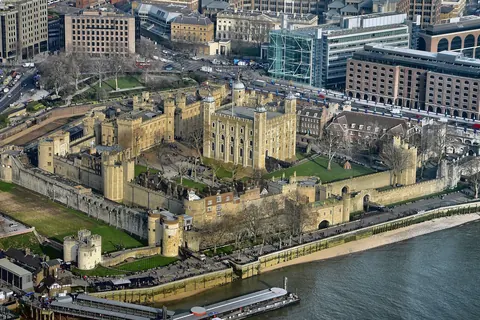
The Tower of London, officially His Majesty’s Royal Palace and Fortress of the Tower of London, is a historic citadel and castle on the north bank of the River Thames in London, England. It lies within the London Borough of Tower Hamlets, which is separated from the eastern edge of the square mile of the City of London by the open space known as Tower Hill. It was founded toward the end of 1066 as part of the Norman Conquest. The White Tower, which gives the castle its name, was built by William the Conqueror in 1078 and was initially a resented symbol of oppression. A grand palace early in its history, it served as a royal residence. The Tower is a complex of several buildings set within two concentric rings of defensive walls and a moat. There were several phases of expansion, mainly under kings Richard I, Henry III, and Edward I in the 12th and 13th centuries.
The Tower of London was besieged several times, and controlling it has been important to controlling the country. The Tower has served as an armoury, a treasury, a menagerie, the home of the Royal Mint, a public record office, and the home of the Crown Jewels of England. From the early 14th century until the reign of Charles II in the 17th century, the monarch would traditionally prepare for several nights at the Tower, and lead a procession from there to Westminster Abbey for their coronation. In the late 15th century, the Princes in the Tower were housed at the castle when they mysteriously disappeared, presumed murdered. Under the Tudors, the Tower was used less as a royal residence, and despite attempts to refortify and repair the castle, its defences lagged behind developments to deal with artillery.
Sources
Text: introduction of the Wikipedia article Tower of London, under the CC BY-SA 4.0 licence (authors: article history). Facts: Wikidata (CC0). Coordinates: Wikidata, map background © OpenStreetMap contributors.